Zero-copy capture engine: CaptureSession and stable FPS
A V4L2 mmap capture loop has an awkward shape for Rust. The kernel owns a ring of buffers, hands one to userland via VIDIOC_DQBUF, expects it back via VIDIOC_QBUF, and considers any pointer into that memory invalid once the buffer is re-queued. Two invariants have to hold at once: only one dequeued frame can be alive at a time, and no slice into the mmap region can outlive the streaming session. A common shortcut is to copy each frame out (buf.to_vec()) and hand the copy to the caller, cheap to write, expensive to run. For a 1080p YUYV stream at 30 fps that is ~124 MB/s of allocator traffic that does nothing useful.
Stage 1 of pi-cam-capture rewires the capture path around a lifetime-parameterised guard so that both invariants are enforced by rustc at compile time. The same guard also owns the FPS pacer: a two-layer design that keeps the kernel cadence honest under both mock and real hardware. This article walks through the design: the guard, the borrowed frame path, the pacer, and the 300-frame smoke test that pins the whole thing down as a CI gate.
Companion repo: pi-cam-capture at commit 7c97f17.
The allocation problem
The V4L2 mmap buffer lifecycle is textbook: VIDIOC_REQBUFS allocates a ring, VIDIOC_QBUF queues each empty buffer, VIDIOC_STREAMON starts capture, VIDIOC_DQBUF blocks until the kernel fills the next one, and VIDIOC_QBUF puts it back on the ring. The v4l crate collapses the whole state machine into Stream::next(), which returns Result<(&[u8], &Metadata)>, a pair of borrows into the mmap region, and re-queues the previous buffer on the next call.
The naive path is:
fn next_frame(&mut self) -> Result<Frame> {
    let (buf, meta) = self
        .stream
        .next()
        .map_err(|err| StreamError::CaptureFailed(err.to_string()))?;

    let timestamp = Self::parse_timestamp(meta.timestamp.sec, meta.timestamp.usec)?;

    Ok(Frame {
        data: buf.to_vec(),
        metadata: FrameMetadata {
            sequence: meta.sequence,
            timestamp,
            bytes_used: meta.bytesused,
        },
    })
}
That buf.to_vec() is the whole cost model of the loop. At 1080p YUYV (4 147 200 bytes/frame) × 30 fps it is 124 MB/s of allocations returned to the allocator one frame later. Zero-copy here means: return the borrow, not the copy. The caller reads the mmap region directly, and the borrow is invalidated (statically) before the next DQBUF.
The rest of the article is about how to expose that borrow without either unsafe or a self-referential struct.
mmap vs DMABUF
V4L2 offers three memory models: mmap, userptr, and DMABUF (V4L2_MEMORY_DMABUF). DMABUF is the interesting one for anything that wants to move pixels between devices without paying for a CPU copy.
With DMABUF the kernel allocates a DMA-coherent buffer and returns a file descriptor. Any device that speaks the DMABUF protocol (a hardware encoder, a compositor, an ISP, a discrete accelerator) can import that fd and DMA-read the buffer directly. The pixels never touch the CPU.
The classic win is a camera-to-encoder pipeline where the encoder is a hardware block. On an RK3588, the RKCIF captures MIPI-CSI2 into a DMABUF, the RKISP3 runs debayer and 3A on the same buffer, and the fd is imported by RKVENC (the H.264/H.265 encoder block) via MPP. At 4K30 NV12, that is roughly 370 MB/s of pixel traffic that stays entirely inside DMA. Most SoCs with a dedicated hardware encoder work the same way.
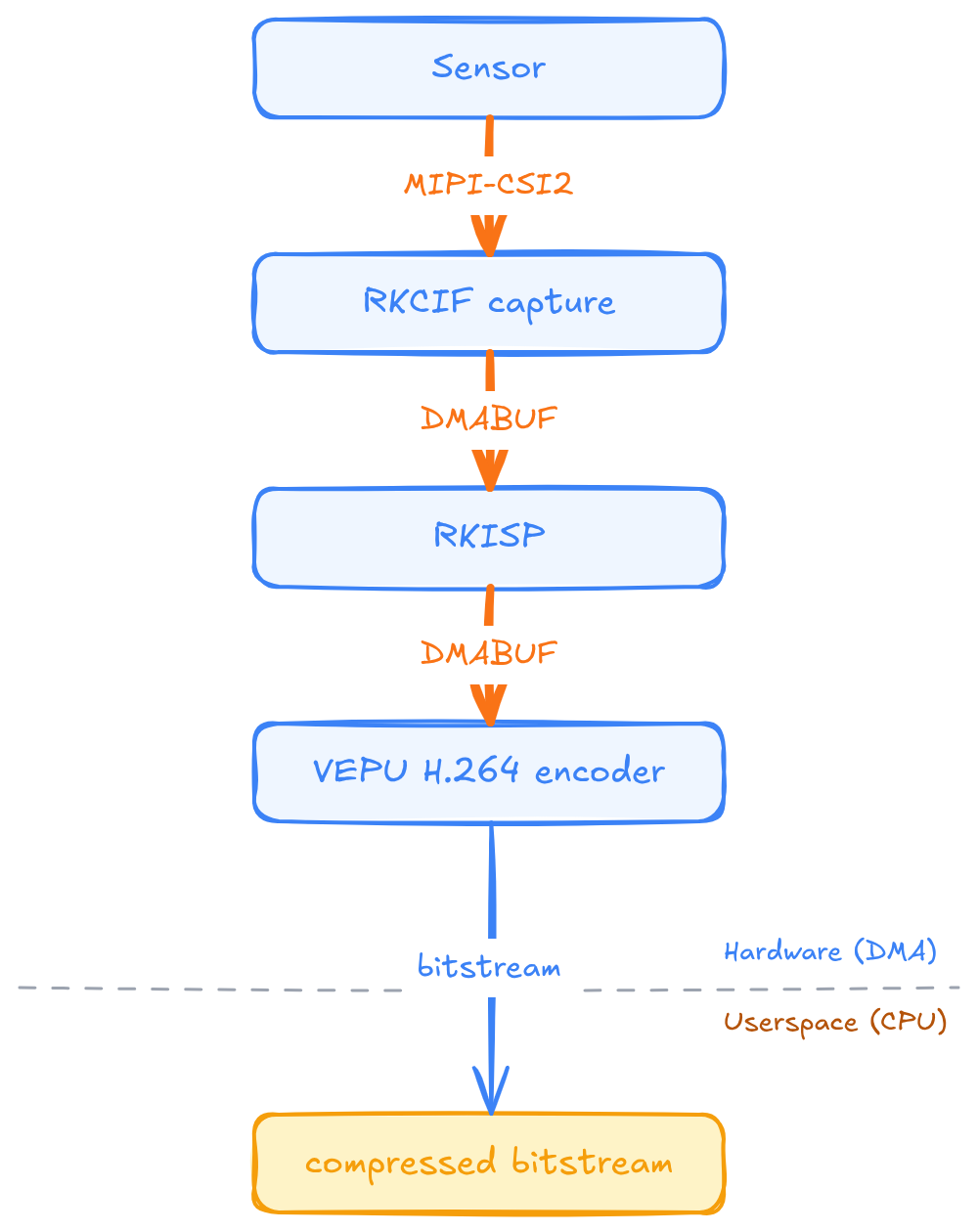
The Pi 5 is on the wrong side of that argument. Broadcom removed the hardware H.264 encoder when they moved to BCM2712, and there is no replacement. Every g2g Pi 5 pipeline ends up in x264 or x265 on the CPU, and software encoders need cache-hot pixels in userspace regardless of what the capture layer chose. DMABUF still helps the camera-to-display path (KMS/DRM can import) and could help camera-to-accelerator paths — the Hailo AI HAT connects via PCIe and HailoRT 4.x is adding DMABUF import support — but for the transport chain g2g targets, none of that changes the fact that the encoder consumer sits on the CPU.
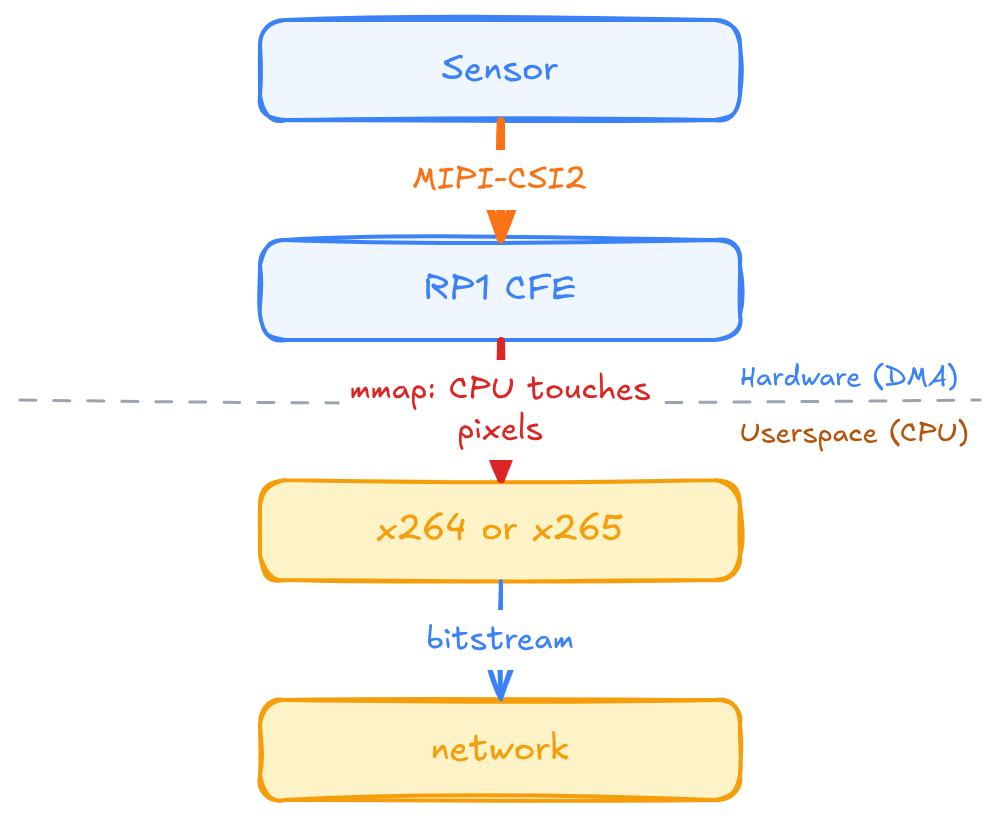
That reduces the mmap-vs-DMABUF choice at the capture layer to two arguments in favour of mmap. First, the v4l crate exposes mmap and userptr streaming, not DMABUF; adding DMABUF would mean raw ioctls or a different driver interface. Second, this stage is single-consumer capture: one reader drains the ring, does no inter-device handoff, and hands the pixels straight to whatever runs next in the same process. mmap is the right tool for that.
DMABUF becomes relevant on Pi 5 in the libcamera backend (article 09) where the camera path can hand frames to the compositor without a CPU round-trip. When that lands, BorrowedCaptureStream will need a companion for fd-based handoff; the current trait returning FrameRef<'_> with a &[u8] is specifically the mmap shape.
The guard pattern
The prior iteration (commit bb09791) put the streaming interface directly on CaptureSession. Here is start_stream:
src/session.rs:124-136 @ bb09791
pub fn start_stream(&mut self) -> Result<()> {
    let stream = self.device.create_stream(self.config.buffer_count, self.config.fps)?;
    self.actual_fps = Some(stream.actual_fps());

    log::info!(
        "Created stream with {} buffers at {} FPS",
        self.config.buffer_count,
        stream.actual_fps()
    );

    // Drop the stream - it's already started, we'll create new ones as needed
    Ok(())
}
And next_frame, further down the same file:
src/session.rs:157-161 @ bb09791
pub fn next_frame(&mut self) -> Result<Frame> {
    // Create a temporary stream for this capture
    let mut stream = self.device.create_stream(self.config.buffer_count, self.config.fps)?;
    stream.next_frame()
}
Two things are wrong with this. First, start_stream creates a Stream and immediately drops it: the buffers are REQBUFS-allocated then torn down, so nothing actually starts. Second, next_frame re-runs the entire REQBUFS → QBUF ×N → STREAMON → DQBUF → STREAMOFF sequence per call. It is functionally correct on vivid (which is unusually tolerant), but the buffer ring is thrown away after each frame. There is no ring, there is a queue of one.
The obvious fix (store the Stream inside CaptureSession) is a self-referential struct, because v4l::Stream<'a> borrows from the Device that lives in the same struct. Rust does not let you write that without Pin, and even with Pin the API becomes hostile.
The chosen shape (commit 62d8607, refined in 7c97f17) is a guard:
pub struct CaptureStream<'a, D: CameraDevice + 'a> {
    stream: D::Stream<'a>,
    actual_fps: u32,
    /// Target interval between consecutive frames for schedule-based pacing.
    target_frame_interval: Duration,
    /// Absolute deadline for the next frame call; `None` before the first call.
    /// Advances by exactly one `target_frame_interval` per call regardless of
    /// actual dequeue duration, maintaining a fixed cadence under varying load.
    next_deadline: Option<Instant>,
}
CaptureStream<'a, D> is the guard. Its lifetime 'a is tied to a &mut CaptureSession<D> borrow through the constructor. (The CaptureStream trait from traits.rs is imported as CaptureStreamTrait in session.rs to avoid the name collision with this struct.)
pub fn streaming(&mut self) -> Result<CaptureStream<'_, D>> {
    let stream = self
        .device
        .create_stream(self.config.buffer_count(), self.config.fps())?;
    let actual_fps = stream.actual_fps();

    log::info!(
        "Created stream with {} buffers at {} FPS",
        self.config.buffer_count(),
        actual_fps
    );

    self.actual_fps = Some(actual_fps);

    Ok(CaptureStream {
        stream,
        actual_fps,
        target_frame_interval: frame_interval(actual_fps),
        next_deadline: None,
    })
}
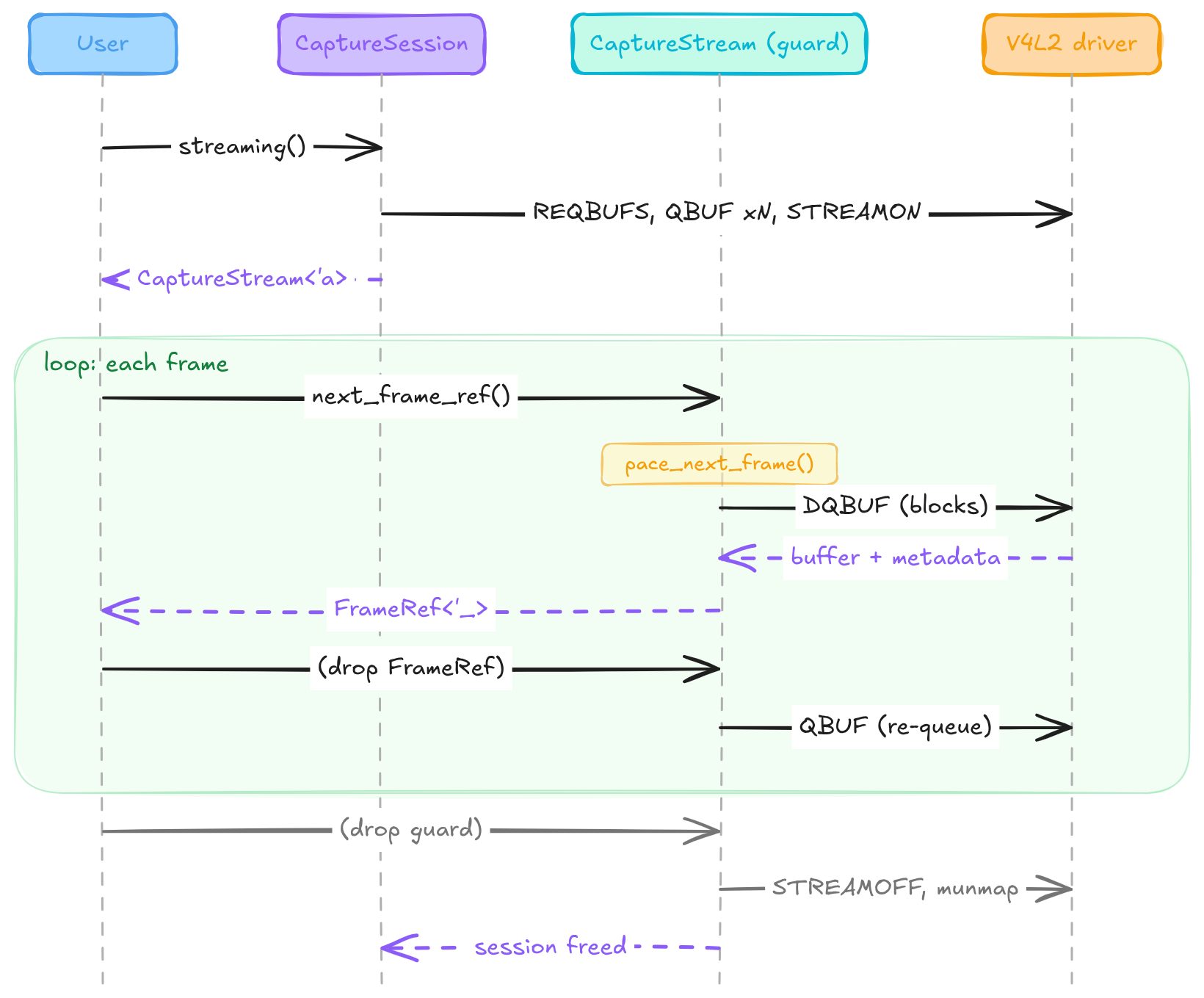
This is Mutex::lock() → MutexGuard, applied to a V4L2 stream. The '_ on the return type is a fresh lifetime tied to &mut self: the guard cannot outlive the session, and while the guard exists no other &mut CaptureSession is possible (so no reconfiguring the format mid-stream). REQBUFS/STREAMON fire once when the guard is constructed; STREAMOFF fires when it drops. The ring persists across the entire lifetime of the guard.
The self-referential problem is dodged by not storing the Stream in CaptureSession at all. The session holds only the Device; the Stream lives in the guard and its 'a binds it back to the session.
The key trait machinery is a GAT on CameraDevice:
pub trait CameraDevice {
    /// The stream type produced by [`create_stream`](Self::create_stream).
    type Stream<'a>: CaptureStream
    where
        Self: 'a;

    /// Returns the device capabilities reported by the driver.
    fn capabilities(&self) -> &DeviceCapabilities;

    /// Queries the current capture format from the driver.
    fn format(&self) -> Result<Format>;

    /// Requests a capture format from the driver.
    ///
    /// The driver may return a different format than requested.
    /// Always use the returned `Format` for subsequent operations.
    fn set_format(&mut self, format: &Format) -> Result<Format>;

    /// Creates a capture stream, allocating `buffer_count` mmap buffers and
    /// targeting `fps` frames per second.
    ///
    /// The returned stream borrows from `self` for its lifetime.
    fn create_stream(&mut self, buffer_count: u32, fps: u32) -> Result<Self::Stream<'_>>;
}
type Stream<'a> is a lifetime-generic associated type. V4L2Device implements it as V4L2Stream<'a> (which internally borrows the v4l::Device); MockDevice implements it as MockStream<'a> (borrowing &mut MockDevice for the shared frame counter). The guard is generic over D, so the same CaptureSession/CaptureStream code drives both real hardware and the mock test device without a runtime branch.
Diagram: guard lifecycle
BorrowedCaptureStream and FrameRef<'_>
Copying every frame is the loud cost. The quiet cost is that a copy-only API forces every downstream consumer (encoder, telemetry, ML pipeline) into the same allocator-heavy pattern even when they only need a read-only view. Stage 1 introduces the borrowed alternative as an opt-in capability trait.
/// Capability for streams that can return a borrowed frame view.
///
/// The returned [`FrameRef`] borrows from `self`, so callers cannot request
/// another frame while the borrowed view is still alive.
pub trait BorrowedCaptureStream {
    /// Captures the next frame as a borrowed view of stream-owned storage.
    fn next_frame_ref(&mut self) -> Result<FrameRef<'_>>;
}
Separate from CaptureStream on purpose. A future replay-from-file stream, or a stream that composites multiple sources, may not have a single stable buffer to borrow from, and forcing every implementation to provide next_frame_ref would be wrong. Two capabilities, opt-in.
FrameRef is just the borrowed twin of Frame:
#[derive(Debug)]
pub struct FrameRef<'a> {
    /// Raw frame data borrowed from the mmap buffer.
    pub data: &'a [u8],
    /// Frame metadata.
    pub metadata: FrameMetadata,
}
The V4L2Stream impl is the direct mapping, handing the v4l crate's borrow through:
impl BorrowedCaptureStream for V4L2Stream<'_> {
    fn next_frame_ref(&mut self) -> Result<FrameRef<'_>> {
        let (buf, meta) = self
            .stream
            .next()
            .map_err(|err| StreamError::CaptureFailed(err.to_string()))?;

        let timestamp = Self::parse_timestamp(meta.timestamp.sec, meta.timestamp.usec)?;

        Ok(FrameRef {
            data: buf,
            metadata: FrameMetadata {
                sequence: meta.sequence,
                timestamp,
                bytes_used: meta.bytesused,
            },
        })
    }
}
Note the lifetime elision: &mut self → FrameRef<'_>. The returned slice borrows from self.stream (via v4l::Stream::next's signature), which in turn borrows from the mmap region owned by the v4l::Stream, whose lifetime is bounded by the underlying Device. The compiler statically prevents:
- Holding two
FrameRefs simultaneously (each requires&mut selfon the stream). - Dropping the guard while a
FrameRefis still alive (guard drop requires no outstanding borrows). - Dropping the session while the guard is alive — the guard borrows the session's device through a
&mutchain rooted at thestreaming()call, so the session cannot be dropped or reborrowed while the guard is alive.
Zero unsafe, zero runtime checks, zero Arc.
The conditional impl on the guard
CaptureStream<'a, D> is generic over D. It should support next_frame_ref when D::Stream<'a> implements BorrowedCaptureStream, and not when it doesn't. Rust expresses that as a conditional inherent impl:
impl<'a, D> CaptureStream<'a, D>
where
    D: CameraDevice + 'a,
    D::Stream<'a>: BorrowedCaptureStream,
{
    /// Capture the next frame as a zero-copy borrowed view.
    ///
    /// The returned [`FrameRef`] borrows from this streaming guard, so another
    /// frame cannot be captured until the returned value is dropped.
    /// May also block to enforce the configured frame rate; see `target_frame_interval`.
    // ...
    #[allow(clippy::same_name_method)]
    pub fn next_frame_ref(&mut self) -> Result<FrameRef<'_>> {
        self.pace_next_frame();
        self.stream.next_frame_ref()
    }
}
next_frame_ref is only in scope when D::Stream<'a>: BorrowedCaptureStream. Both V4L2Stream and MockStream satisfy it, so the method is available for production and mock code alike; a future stream that opts out simply never gets the method. There is a parallel impl BorrowedCaptureStream for CaptureStream<'a, D> at src/session.rs:388-399 that satisfies the trait for generic contexts. Rust's method resolution picks the inherent method when the concrete type is known; the trait impl — which delegates to the inherent method — is needed for callers operating through a &mut dyn BorrowedCaptureStream or a generic T: BorrowedCaptureStream bound. Unit test test_capture_stream_implements_borrowed_capture_stream_trait in src/session.rs:673-689 exercises exactly this path.
The mock: scratch buffer as borrow target
The V4L2 case has an mmap region to borrow from. The mock has to conjure one:
pub struct MockStream<'a> {
    device: &'a mut MockDevice,
    pattern: TestPattern,
    fps: u32,
    buffer_count: u32,
    current_frame: Vec<u8>,
    /// Injects a `CaptureFailed` error after this many successful frames. `None` means no error.
    error_after: Option<u32>,
}
current_frame is the scratch buffer. Each call overwrites it in place and returns a slice into it:
impl BorrowedCaptureStream for MockStream<'_> {
    fn next_frame_ref(&mut self) -> Result<FrameRef<'_>> {
        self.check_error()?;
        let format = &self.device.format;
        write_test_frame(&mut self.current_frame, format, self.pattern);
        // Use actual buffer length so bytes_used is correct even for MJPG (where format.size == 0)
        #[allow(clippy::cast_possible_truncation)] // frame sizes fit in u32 in practice
        let bytes_used = self.current_frame.len() as u32;
        let metadata = self.next_metadata(bytes_used);

        Ok(FrameRef {
            data: &self.current_frame,
            metadata,
        })
    }
}
The unit test test_mock_stream_borrowed_capture_reuses_scratch_buffer (src/mock.rs:407-431) captures two frames and asserts first_ptr == second_ptr, proving that the mock behaves like the real device: the scratch buffer is reused, not reallocated. This matters because the mock is the substrate for the pacer unit tests, and any hidden allocation would skew timing measurements.
FPS pacing, two layers
Zero-copy handles bandwidth. It does not handle jitter. A downstream encoder or WebRTC transport expects a metronome; a capture path that oscillates between 25 fps and 40 fps loses that even when its mean is right. Stage 1 stabilises FPS with two independent mechanisms.
Layer 1: kernel, VIDIOC_S_PARM before REQBUFS
The first layer is the driver. VIDIOC_S_PARM sets timeperframe, the interval the driver will hold on DQBUF before delivering the next buffer. For vivid, this is honoured to the microsecond. For real hardware it is honoured approximately: sensor pixel clocks, MIPI CSI-2 packing, and ISP pipeline latencies all conspire to make the actual interval drift.
The critical detail is ordering. REQBUFS locks the driver into a specific streaming configuration; some drivers ignore S_PARM after REQBUFS (or reject it outright). The prior code called Stream::with_buffers, which fires REQBUFS, before set_fps. The new code inverts the order:
pub fn new(device: &'a Device, buffer_count: u32, target_fps: u32) -> Result<Self> {
    // Set FPS before allocating mmap buffers; some drivers ignore S_PARM after REQBUFS.
    let actual_fps = Self::set_fps(device, target_fps)?;

    // Create the mmap stream
    let stream = Stream::with_buffers(device, Type::VideoCapture, buffer_count)
        .map_err(|err| StreamError::StartFailed(err.to_string()))?;

    // Log if the driver negotiated a different FPS
    if actual_fps == target_fps {
        log::info!("Stream configured for {actual_fps} FPS");
    } else {
        log::warn!("Requested {target_fps} FPS, but driver set {actual_fps} FPS");
    }

    Ok(Self { stream, actual_fps })
}
set_fps itself is a straightforward G_PARM → mutate → S_PARM sequence returning the driver's rounded-off actual interval (src/stream.rs:72-107). The driver may round to the nearest supported rate (e.g. 30 → 25 on a PAL sensor); the returned actual_fps is what the userland pacer must target.
Layer 2: userland schedule-based pacer
Layer 1 is imprecise on real hardware. A camera nominally running at 30 fps may deliver frames at 33.4 ms ± 2 ms. That is fine for the long-run mean but bad for anything that lays frames onto a fixed transmit clock. The userland layer trims this by holding a schedule and sleeping to it.
fn pace_next_frame(&mut self) {
    let now = Instant::now();
    if let Some(deadline) = self.next_deadline {
        if now < deadline {
            std::thread::sleep(deadline - now);
        }
        // Advance deadline by one interval regardless of actual sleep duration, so the
        // pacer maintains a fixed cadence even when kernel dequeue time consumes the gap.
        self.next_deadline = Some(deadline + self.target_frame_interval);
    } else {
        self.next_deadline = Some(now + self.target_frame_interval);
    }
}
Two design points.
Deadline advances by exactly one interval, always. The alternative is to track "last frame time" and compute next_deadline = last_frame_at + interval. That works when calls are punctual but drifts when they are not. If the kernel takes 40 ms to hand over a "30 fps" frame, last_frame_at + interval puts the next deadline 33.33 ms after the late arrival. The pacer then does nothing (deadline already passed on entry) and the schedule slips permanently. Advancing the deadline by +interval from its previous value pins the schedule to wall-clock time; late arrivals catch up on the next call rather than pushing every subsequent frame back.
No debt accumulation. If several consecutive frames run long, now can pass deadline by more than one interval. The code does not sleep in that case; it simply skips the sleep and advances the deadline by one interval. That means brief overloads produce a short burst of tight-cadence frames followed by a return to the schedule, bounded by wall-clock, not by whatever backlog built up. The alternative (sleep until the accumulated debt is paid) can lock the loop into permanent zero-fps under transient overload; this is the classic "cascading deadline miss" failure mode.
Both callsites route through pace_next_frame before touching the kernel:
#[allow(clippy::same_name_method)]
pub fn next_frame(&mut self) -> Result<Frame> {
    self.pace_next_frame();
    self.stream.next_frame()
}
On the vivid virtual device Layer 2 rarely fires: the kernel is already delivering frames at exactly 33.33 ms and deadline - now is small or negative. On a real IMX477 or IMX708, Layer 2 is expected to become the trim: whenever the sensor delivers early, the pacer absorbs the difference; when it delivers late, the pacer yields immediately and the next frame's deadline is offset from the ideal schedule, not from the late arrival.
Neither layer alone is sufficient. Layer 1 alone is what real cameras give you: an approximate cadence with sensor-driven jitter. Layer 2 alone (with S_PARM unset) would race against a driver delivering as fast as it can, and the sleep floor would compete with DQBUF's blocking; on any frame where the kernel already held for the interval, the pacer would sleep on top of that hold and overshoot.
Diagram: pacer with a slow producer
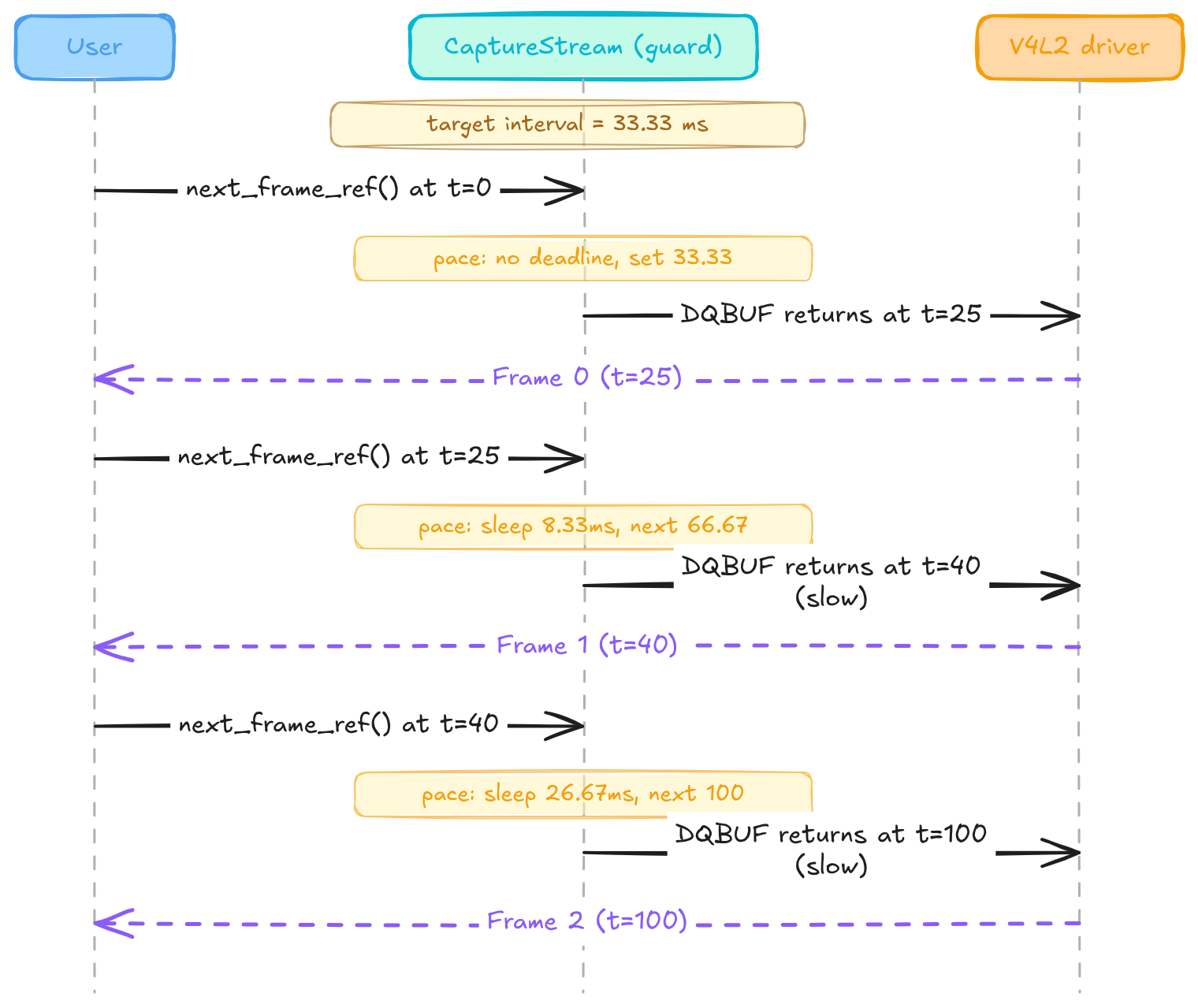
Deadlines land on 33.33, 66.67, 100.00 regardless of individual dequeue durations. A tardy frame at t=40 does not push the next deadline to t=73.33: it stays at t=66.67, and the pacer sleeps a shorter interval to recover.
The 300-frame smoke test
The article's payoff is a repeatable CI gate. Without one, "stable FPS" is an assertion; with one it is a fact anyone can reproduce on vivid.
tests/vivid_integration.rs:233-304
#[test]
#[serial]
fn test_vivid_fps_stability() {
    const FRAME_COUNT: usize = 300;
    const MIN_MEAN_MS: f64 = 31.67;
    const MAX_MEAN_MS: f64 = 35.00;
    const MAX_STD_DEV_MS: f64 = 3.0;

    let device_index = require_vivid!();
    let config = CaptureConfig::builder()
        .device(device_index)
        .resolution(640, 480)
        .format(FourCC::YUYV)
        .fps(30)
        .buffer_count(4)
        .build()
        .expect("vivid capture config should be valid");

    let mut session = CaptureSession::new(config).expect("Failed to create vivid session");
    let mut stream = session.streaming().expect("Failed to create vivid stream");
    let mut call_starts = Vec::with_capacity(FRAME_COUNT);

    for _ in 0..FRAME_COUNT {
        call_starts.push(Instant::now());
        let frame = stream
            .next_frame_ref()
            .expect("Failed to capture borrowed frame");
        assert!(
            frame.metadata.bytes_used > 0,
            "Bytes used should be positive"
        );
    }
    // ... interval math + assertions
}
The shape matters as much as the numbers.
Timestamps are taken before next_frame_ref, not after. The measured interval is the interval between call entries, the period from the caller's point of view. That is the metric a downstream encoder actually cares about (when does the next frame arrive at my input?), not the period from DQBUF return to the next DQBUF return.
FrameRef drops at the end of the loop body. The frame binding goes out of scope before the next iteration writes to call_starts, so the borrow does not conflict with the Vec<Instant>. This is the exact invariant the trait design promises: only one FrameRef alive at a time, and the compiler enforces it in the test body just as in production code.
Thresholds. Mean ∈ [31.67, 35.00] ms is ±5% around the ideal 33.33 ms, the tolerance that any real 30 fps consumer allows. σ < 3 ms bounds the jitter. Both must hold: a stream that runs at 32 ms mean but oscillates between 20 and 44 ms has the right average and is still useless.
The assertions include actual_fps, min, max, and σ in their failure messages so a CI failure gives everything needed to triage without a rerun.
tests/vivid_integration.rs:294-303
    assert!(
        (MIN_MEAN_MS..=MAX_MEAN_MS).contains(&mean_ms),
        "Mean {mean_ms:.2} ms outside [{MIN_MEAN_MS:.2}, {MAX_MEAN_MS:.2}] ms \
         (actual_fps={actual_fps}, min={min_ms:.2}ms, max={max_ms:.2}ms, σ={std_dev_ms:.2}ms)"
    );
    assert!(
        std_dev_ms < MAX_STD_DEV_MS,
        "σ {std_dev_ms:.2} ms >= {MAX_STD_DEV_MS:.2} ms \
         (actual_fps={actual_fps}, mean={mean_ms:.2}ms, min={min_ms:.2}ms, max={max_ms:.2}ms)"
    );
The test is gated on the integration feature (#![cfg(feature = "integration")] at the top of the file) and on vivid being loaded. The require_vivid! macro panics with the exact command to load vivid: fail-loud, not fail-silent. This is the article-02 rule enforced at test level: any environment that cannot capture is a broken environment, not a skipped one.
The vivid setup (loading the module and configuring webcam-style inputs) is covered in Integration Testing for Linux Video Pipelines.
Design decisions and trade-offs
Why a guard, not a self-referential struct. The self-referential shape is expressible with Pin + unsafe, but every downstream API becomes awkward and the crate's unsafe_code = "forbid" lint has to be relaxed. The guard shape puts the same borrow relationship in the type system, with CaptureStream<'a, D> where 'a binds back to the session, and stays entirely in safe Rust.
Why a separate BorrowedCaptureStream trait. Zero-copy is not a universal capability. A stream that composites multiple sources, or one backed by network-received compressed frames, may not have a stable buffer to borrow from. Splitting the trait keeps CaptureStream viable for streams that cannot borrow, while next_frame_ref is available on any guard whose inner stream opts in.
Why schedule-based pacing over interval-since-last. Interval-since-last drifts because the reference point moves with the frame arrivals. If the kernel takes 40 ms to hand over a "30 fps" frame, last_frame_at + interval puts the next deadline 33.33 ms after that late arrival, so the schedule slips permanently. Schedule-based pacing pins the reference to wall-clock: the deadline advances by exactly one interval from its previous value, so late arrivals catch up on the next call instead of dragging the whole schedule with them.
Why the pacer lives in the guard, not the stream. The pacer needs to fire on both next_frame and next_frame_ref uniformly. Putting it in the stream would either force every implementation to duplicate the sleep logic (V4L2Stream, MockStream, and any future stream) or force it into a shared helper that the trait would have to expose. Putting it in the guard makes it a single implementation applied uniformly, and it composes naturally with the guard's lifetime.
Why fail-loud on missing vivid. Silently skipping the test would turn a broken CI environment into a green build. The require_vivid! macro panics; missing vivid is treated as a test failure, and the panic message includes the exact remediation command.
What's next
The guard now runs at a stable cadence and the borrow checker keeps the buffer protocol honest. Two threads open up from here.
The first is format: the tests all run at YUYV 640×480 because that is what vivid gives you. Real cameras negotiate. Sensor-native formats (SRGGB10 on the IMX477, SBGGR10 on the IMX708), stride quirks, driver-preferred resolutions. Article 04 walks through format negotiation, the VIDIOC_ENUM_FMT / VIDIOC_TRY_FMT / VIDIOC_S_FMT dance, and how the Format type's stride and size fields interact with driver rounding.
The second is control. Zero-copy and stable FPS are the transport layer of the capture path; exposure, gain, white balance, and (on the IMX708) autofocus are the content layer. Article 05 covers V4L2 controls via the v4l::Control interface, the difference between camera-specific and standard controls, and how per-frame control changes interact with the buffer ring you now understand.